InBody vs. DEXA in Fort Collins
If you have been comparing an InBody scan and a DEXA scan, you can get an InBody 570 body composition analysis at our family-owned office in Fort Collins. We offer InBody testing here. We do not offer DEXA.
Both methods can show more than a bathroom scale, but they do not work the same way, and they are not a perfect substitute for each other. This page is an honest comparison so you can decide what you need. An InBody scan is a body composition measurement, not a medical visit, and it does not replace the care of your clinician. If your physician has ordered a DEXA scan, especially for bone density, that is the test to follow.
I am Matt, and I have been reading InBody reports almost every day for about 13 years. Readers of NOCO Style voted us Best Nutritionist in the magazine's Best of NOCO contest in 2022, 2023, and 2024, and Best Health and Wellness Coach in 2022, and we placed in the top 3 for Best Nutritionist in 2025. If you want the general overview of our scan, see our InBody body composition analysis page. This page is about how InBody and DEXA compare, and when I would point you toward one or the other.
How an InBody 570 scan works
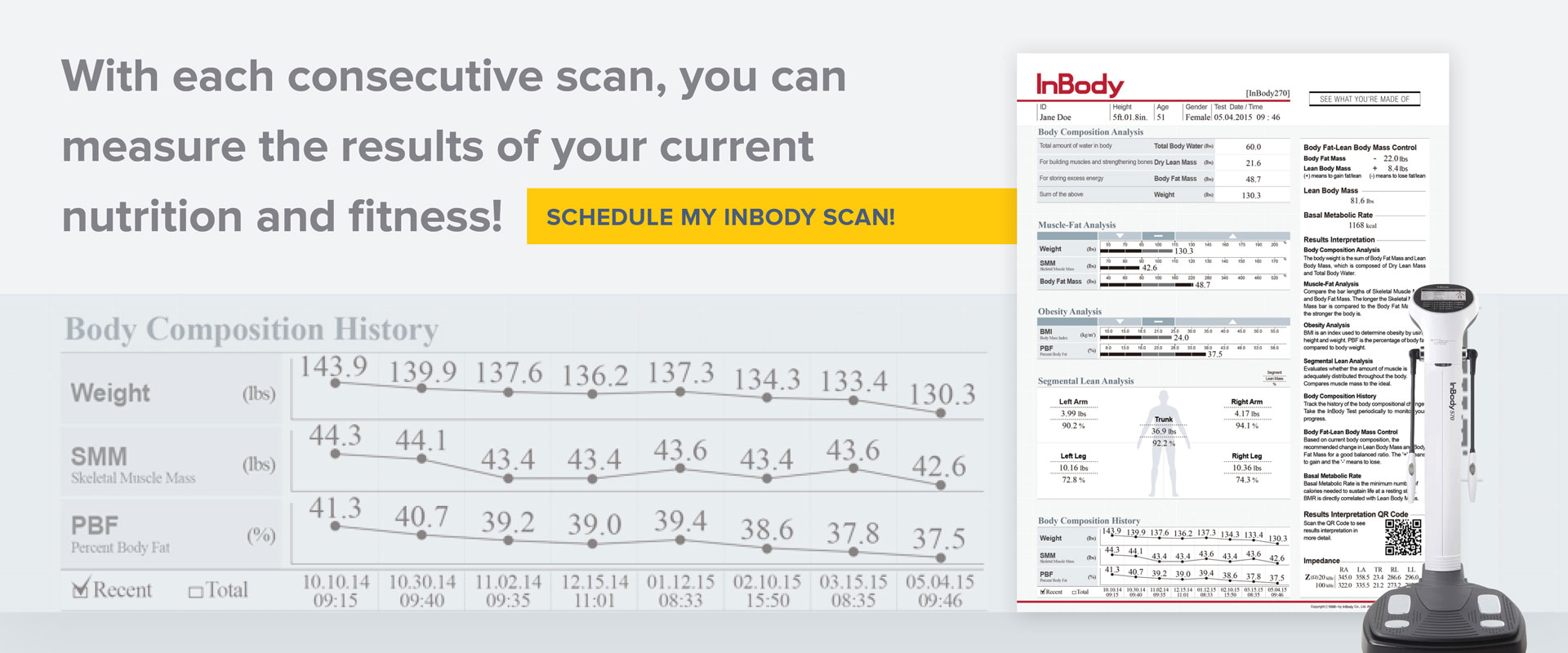
The InBody 570 uses multi-frequency bioelectrical impedance analysis. You stand on the unit and hold the handles. A small electrical current moves through your body, and the device measures impedance in five segments: both arms, both legs, and the trunk.
From that reading, the report includes:
Skeletal muscle mass, including a segmental breakdown so you can see how muscle is distributed
Body fat
Visceral fat
Body water
The scan itself is quick. Then we sit down and walk through the report together. If you come back, we compare the new results with earlier scans in LookinBody, so we can see what changed in muscle, fat, and water, not just whether your weight went up or down.
How a DEXA scan works
A DEXA scan, also written as DXA, stands for dual-energy X-ray absorptiometry. It uses a low-dose X-ray to tell tissues apart based on how they absorb the beam. You typically lie still on a padded table while a scanner arm moves over you.
DEXA is used in two related but not identical ways. A bone density DEXA usually looks at sites such as the hip and spine, and it is the standard test clinicians use when they want to check bone strength or look for osteoporosis. A whole-body DEXA can also be used to measure body composition: fat mass, lean mass, and bone mineral content.
Bone density is a clear strength of DEXA. An InBody 570 scan does not measure bone density, and it is not a substitute for a DEXA your clinician has ordered for that purpose.
We do not offer DEXA at Colorado Nutrition. If you need one, that is something to arrange with your clinician or an imaging provider.
InBody vs. DEXA at a glance
How it works
InBody 570 (at our office): Multi-frequency bioelectrical impedance. You stand on the unit and hold the handles.
DEXA (not offered here): Low-dose X-ray. You typically lie on a table while a scanner moves over you.
What it measures
InBody 570 (at our office): Skeletal muscle mass (including a segmental breakdown), body fat, visceral fat, and body water
DEXA (not offered here): Fat mass, lean mass, and bone. A bone density DEXA, usually at the hip and spine, is the standard test for bone strength.
Radiation
InBody 570 (at our office): None
DEXA (not offered here): A small amount of X-ray radiation. The dose is very low, but DEXA is typically avoided during pregnancy.
Best used for
InBody 570 (at our office): Frequent tracking of muscle, fat, and water when testing conditions are consistent
DEXA (not offered here): Bone density, a physician-ordered scan, or a reference-style body composition measurement
How often
InBody 570 (at our office): Practical for regular follow-ups, such as every 4 to 6 weeks
DEXA (not offered here): Not usually used as a month-to-month tracking tool
At Colorado Nutrition
InBody 570 (at our office): Yes. A single scan is $40, including a sit-down with me. Packs are 3 for $100, 5 for $150, and 10 for $250.
DEXA (not offered here): No. We do not offer DEXA.
Accuracy and consistency, honestly
DEXA is often treated as a reference method when researchers compare other body composition tools, including bioelectrical impedance. In general terms, it is a more direct imaging measurement of fat, lean tissue, and bone. That does not mean every DEXA number is perfect, and it does not mean an InBody scan is not useful.
An InBody 570 scan estimates body composition from impedance. The reading can shift if you are unusually hydrated, have just eaten a large meal, or have just worked out. When you test under similar conditions, it is a consistent way to watch trends over time, which is how I use it in the office.
The two reports also do not use identical labels. DEXA reports lean mass, which is not the same thing as the skeletal muscle mass on an InBody report. I would not expect the numbers to match exactly, and I would not treat a single InBody reading as if it were a lab diagnosis. If your clinician wants a DEXA for bone density or another medical reason, that is the test to get.
Radiation, cost, access, and how often you can test
An InBody scan does not use X-rays. A DEXA scan uses a small amount of X-ray radiation. The dose is very low — much less than a chest X-ray — but because it is still radiation, DEXA is typically avoided during pregnancy, and it is not usually used as a frequent, month-to-month tracking tool. If you are pregnant or think you might be, that is a question for your clinician.
Cost and access also differ. A single InBody 570 analysis at our office is $40 and includes a sit-down with me to go over your results. Packs are 3 for $100, 5 for $150, and 10 for $250. DEXA is generally done at a hospital, clinic, or imaging center, and a bone density scan is often ordered by a physician. Pricing varies by provider and by whether the scan is for bone density or whole-body composition, so I will not quote other providers' prices here.
If you want to retest often — for example every 4 to 6 weeks while you are on a GLP-1, or on a steady schedule during a nutrition plan — InBody is the more practical option at our office. That 4-to-6-week interval is a practical one for watching trends, not a medical rule.
When to choose DEXA, and when to choose InBody
Choose a DEXA scan, through your clinician or an imaging provider, if:
You need a bone density test, or you have questions about bone strength or osteoporosis
Your physician has ordered a DEXA
You want a reference-style body composition measurement and you do not need to repeat the test frequently
Choose an InBody 570 scan at our office if:
You want a clear reading of skeletal muscle, fat, visceral fat, and body water, plus a sit-down to go over the report
You want to track changes on a regular schedule, including every 4 to 6 weeks on a GLP-1 or during a nutrition plan
You were referred by a prescriber for a body composition scan, or you simply want a baseline without being in a coaching program
These are not always either-or. Some people get a DEXA when their clinician wants bone density information, and they use InBody at our office to watch muscle, fat, and water between those visits.
How to prepare for a consistent InBody reading
The scan itself is quick. You will stand on the InBody 570 and hold the handles while it takes the reading. Then we sit down and go through the report together so you know what you are looking at.
If this is a follow-up visit, I will compare your new results with your earlier scans in LookinBody.
For the most useful reading, try to come in a fairly normal state:
Not right after a large meal or a hard workout
Not unusually dehydrated or over-hydrated
After using the restroom, if you can
Without lotion on your hands and feet, so the electrodes can make a clean contact
If you are coming back for a follow-up, try to test at a similar time of day, under similar conditions, so the comparison is fairer.
Price and what's included
A single InBody 570 analysis is $40. That includes a sit-down with me to go over your results.
If you already know you want to track over time, packs are:
3 analyses for $100
5 analyses for $150
10 analyses for $250
If you plan to retest every 4 to 6 weeks, a pack can be a straightforward way to stay on a schedule. Follow-up scans are compared in LookinBody, so we can see what changed in fat, muscle, and water, not just whether your weight went up or down.
You can book a scan on its own. You do not have to be in an ongoing nutrition coaching program.
Other tests and pages that may help
If you are on a GLP-1 and want to keep an eye on muscle, see our InBody scans for GLP-1 muscle tracking page. If you also want a measured calorie baseline instead of a formula, an RMR test for GLP-1 and TDEE can sit alongside an InBody scan. And if you want a nutrition plan built around those numbers, we can talk about that too.
Our office is in Fort Collins. I also see people who drive in from Loveland, Windsor, Timnath, Wellington, and Greeley when they want a scan and someone to go through the report with them.
Common questions
Do you offer DEXA scans?
No. Colorado Nutrition offers InBody 570 scans, not DEXA. If you need a DEXA scan, especially for bone density or because your physician has ordered one, that is something to arrange with your clinician or an imaging provider. An InBody scan is not a substitute for that test.
Which is more accurate, InBody or DEXA?
DEXA is often treated as a reference method when researchers compare other body composition tools. It is a more direct imaging measurement of fat, lean tissue, and bone. An InBody 570 scan estimates body composition from impedance, and the reading can shift if you are unusually hydrated, have just eaten, or have just worked out. When you test under similar conditions, InBody is a consistent way to watch trends over time. The two reports also use different labels, so I would not expect the numbers to match exactly.
How much does an InBody scan cost?
A single InBody 570 analysis is $40. Packs are 3 for $100, 5 for $150, and 10 for $250. The price includes a sit-down with me to go over your results.
Can I use InBody to track changes if I am on a GLP-1 or a nutrition plan?
Yes. If you want to retest on a regular schedule, including every 4 to 6 weeks while you are on a GLP-1 or during a nutrition plan, InBody is a practical way to watch muscle, fat, and water over time. That interval is a practical one for watching trends, not a medical rule. An InBody scan does not replace the care of your clinician.
Does an InBody scan use radiation?
No. An InBody scan uses bioelectrical impedance, not X-rays. A DEXA scan uses a small amount of X-ray radiation. The dose is very low — much less than a chest X-ray — but DEXA is typically avoided during pregnancy. If you are pregnant or think you might be, that is a question for your clinician.
How should I prepare for an InBody scan?
For the most useful reading, come in a fairly normal state: not right after a large meal or a hard workout, and not unusually dehydrated or over-hydrated. Use the restroom first if you can, and avoid lotion on your hands and feet so the electrodes can make a clean contact. If you are coming back for a follow-up, try to test at a similar time of day, under similar conditions.
Do I have to be a nutrition coaching client to book a scan?
No. You can book an InBody analysis on its own. That includes people who were sent in by a prescriber and people who just want a clear reading of fat, muscle, and water.

Book your InBody scan
Ready to get a clear reading of muscle, fat, and water? Book an InBody 570 analysis at Colorado Nutrition, 3926 John F. Kennedy Parkway, Suite 9A, Fort Collins, CO 80525. We are here Monday through Friday, 8:30 a.m. to 2:00 p.m. If you have any trouble with the scheduler, email info@coloradonutrition.com or call (720) 255-1627.